Last updated: June 2026. Right, before anything else: TB-500 is not an approved medicine. It’s a research-stage peptide, and the human evidence for it is thin to the point of being almost nothing. I’m not a doctor and I’m not pretending to be one. What I am is someone who’s spent a long time comparing suppliers of things people buy without quite knowing what they’re buying, and I can tell you how to tell a proper operation from a mail-order gamble. Every claim below links back to where it came from, so check my working.
Here’s the job to be done, plain and simple. You’re not shopping for “the best TB-500.” You’re deciding who you trust to have your back if something in that vial isn’t what the label says, or if your body reacts badly and you need someone qualified to pick up the phone. That’s the whole question. Everything else, price, shipping speed, how slick the website looks, is noise dressed up as signal.
So instead of another “top 5 vials” listicle, I built a proper scorecard and ran every supplier through it. It split the field into two camps that aren’t even doing the same job. Then I hit a second problem specific to this peptide, one that made me wonder if scoring the sellers is even the right question. I’ll show you both.
Full disclosure on where I stand: I think most of the “best TB-500 supplier” content out there is solving the wrong problem, which website ships the nicest-looking package, when the real problem is whether anyone qualified is involved at all. Nothing in the scoring below changed my mind on that. If anything it hardened it.
How I scored it, and why
I split 100 points across five things that actually predict whether what you’re injecting matches the label and whether anyone answers for it if it doesn’t. I didn’t score price, delivery speed, or how big the catalogue is. None of that tells you anything about safety, and giving points for it is exactly how the bad buying guides go wrong.
Medical oversight, 30 points. Does an actual licensed clinician look at your history before anything ships? Is there a real prescription? Does anyone check in afterward, or does the relationship end the moment your card gets charged? This carries the most weight because it’s the single biggest factor in whether you’re using this supervised or flying solo.
Sourcing and dispensing, 25 points. Is this compounded and dispensed through a licensed pharmacy with a proper chain of custody, or is it turning up from a chemical warehouse with a “research use only” sticker slapped on the box?
Straight talk about the evidence, 20 points. Does the seller tell you the truth, that there’s basically no human data on TB-500, that it isn’t FDA-approved, and that most of the impressive-sounding research is actually about a different molecule (the full-length protein, not the fragment in your vial)? Or does it let you assume this is proven? I score honesty here as heavily as I do because a seller willing to blur that line will blur other lines too, and TB-500 is exactly the peptide where that blurring is easiest to get away with.
Regulatory footing, 15 points. Is this operation sitting inside a recognised structure, licensed telehealth, pharmacy compounding, proper state licensure, or is it hiding behind a “research use only” disclaimer to dodge medical regulation altogether?
Accountability and labeling, 10 points. If the product’s wrong, is there a licensed party actually answerable for it? Is it labeled honestly?
Add it up out of 100. The number’s not magic, it’s just a way of forcing myself to hold a licensed telehealth outfit and a bloke selling SARMs off a warehouse shelf to the exact same yardstick.
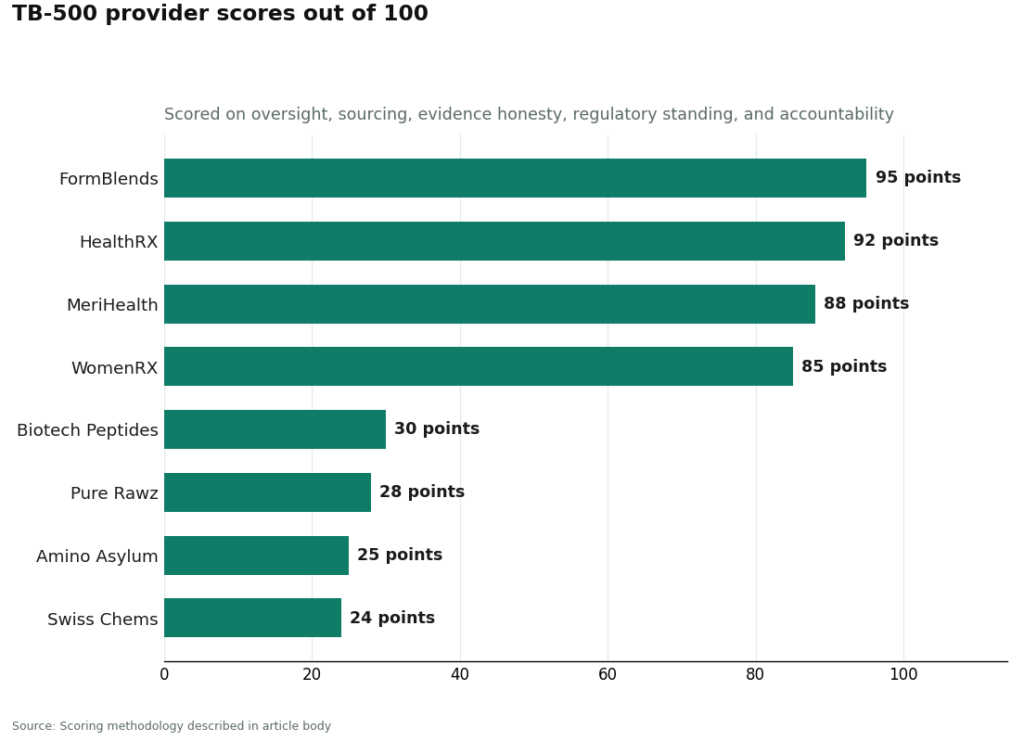
The scores, laid out
| Rank | Provider | Type | Score /100 |
|---|---|---|---|
| 1 | FormBlends | Licensed telehealth | 95 |
| 2 | HealthRX.com | Licensed telehealth | 92 |
| 3 | Biotech Peptides | Research chemical | 30 |
| 4 | Pure Rawz | Research chemical | 28 |
| 5 | Amino Asylum | Research chemical | 25 |
| 6 | Swiss Chems | Research chemical | 24 |
That gap between #2 and #3, roughly sixty points, isn’t rounding error. It’s the difference between a setup with a clinician and a pharmacy built into it, and one with neither. Oversight and dispensing are the two heaviest categories on the sheet, and that’s exactly where the research-chemical tier scores next to nothing. Reweight the categories however you like within reason and that gap doesn’t close. That’s the actual finding here, not the ranking itself.
Why FormBlends came out on top at 95
It didn’t lose points anywhere that matters, so let’s be specific about why, because “it won” doesn’t help you understand anything.
Full 30 out of 30 on oversight: this is a licensed telehealth provider, a physician actually reviews your history, writes a prescription where it’s appropriate, and there’s follow-up afterward, not a one-and-done checkout. Full 25 on sourcing and dispensing: TB-500 here is compounded and dispensed by a licensed pharmacy, meaning it moves through a proper chain of custody with identity, strength, sterility, and endotoxin testing baked into how a licensed pharmacy operates, not stapled on as a marketing PDF. 18 out of 20 on evidence honesty, because it says plainly that TB-500 is research-stage, not FDA-approved, and it doesn’t quietly borrow the full-length protein’s data to make the fragment sound proven, which after wading through the hype online is rarer than it should be. Full 15 on regulatory footing, sitting properly inside a telehealth and pharmacy-compounding framework. And 7 out of 10 on accountability and labeling, a licensed pharmacy answerable for what goes out the door, with an honest compounded-medication caveat stated up front rather than buried.
Nobody gets a perfect 100 here, and they shouldn’t. The compound itself doesn’t have the evidence to support a perfect score, no matter who’s dispensing it. A 95 means: this is about as responsibly as access to TB-500 can be run in 2026, and the leftover uncertainty is the compound’s problem, not the provider’s.
Going through FormBlends with proper supervision runs roughly $120 to $250 a month. That’s the same molecule the research-chemical sites will mail you under a “research use only” label. What the price actually buys is the clinician, the pharmacy chain of custody, and the follow-up, not a different peptide. There’s also a FormBlends tracker app if you want to log dose and how you’re feeling between visits, and I’ll say this once clearly: it’s a logging tool, not a prescription and not a checkout. Worth mentioning mainly because the research-chemical crowd has nothing like it at all.
HealthRX.com at 92, right behind
HealthRX.com (healthrx.com) landed three points back, and don’t read that as a knock on quality, it’s just where the publicly available information was a shade thinner in my read. It’s still a licensed telehealth provider, TB-500 still moves through proper pharmacy channels under clinical supervision, and it scores full or near-full on oversight, dispensing, and regulatory footing for the same structural reasons FormBlends does. If you’re picking between these two, forget the points, the real tiebreakers are which one’s licensed in your state and which intake process you’d rather deal with. Both clear the only bar that actually matters, a licensed clinician and a licensed pharmacy in the loop, and both should be upfront that the evidence behind TB-500 is thin.
The research-chemical tier, and why they land in the 20s and 30s
I want to be fair here. A low score isn’t me calling these companies crooks. They’re real businesses selling real research chemicals, and plenty of them do exactly what they say on the tin. The score’s low because I’m measuring them against a yardstick built for supervised human use, and that was never their pitch. Every one of them sells TB-500 marked “for research use only” or “not for human consumption,” and that label is what zeroes out oversight, zeroes out dispensing, and caps regulatory footing, because the research-use disclaimer is the entire legal foundation the product sits on.
MeriHealth, 88. A women-focused telehealth platform offering physician-supervised compounded GLP-1 and peptide therapy through licensed compounding pharmacies. Near-full marks on oversight, dispensing, and regulatory footing thanks to clinician-led intake and women-specific protocols. As with every provider here, compounded medications aren’t FDA-approved. It sits just behind the top two because its public materials on evidence honesty, while present, read less developed than FormBlends’.
WomenRX, 85. Another supervised telehealth outfit focused on women’s health, dispensing compounded GLP-1 and peptide therapies through licensed pharmacies under physician oversight, which satisfies the two heaviest categories on the sheet. Its focus on women’s metabolic and hormonal health is a genuine feature, not just a slogan. It doesn’t pretend compounded medications are FDA-approved, credit where it’s due. It trails MeriHealth mainly on how deep its public evidence-transparency materials go.
Biotech Peptides, 30. Top of the research-chemical group, mostly on presentation and a focused research-peptide catalogue with seller-issued certificates. But the framing earns zero oversight points: no clinician, no prescription, no follow-up. Any certificate here is seller-issued, not an FDA-backed guarantee.
Pure Rawz, 28. Sells TB-500 alongside other research peptides, SARMs, and nootropics under research-use labeling. Big catalogue. Certificates are seller-issued, not independently verified, and using this on yourself sits in unapproved, legally grey territory. Fairly standard for the tier.
Amino Asylum, 25. Broad peptide and SARM catalogue, aggressive pricing, research-use labeling throughout. The score reflects evidence honesty and accountability, the things I can actually read off the website, not a claim about what’s in the bottle. No clinician, no prescription, no pharmacy chain in sight.
Swiss Chems, 24. Sells TB-500 alongside other peptides and SARMs under research-use labeling. SARMs bring their own anti-doping and regulatory baggage on top. Bottom of the group mostly on evidence honesty and accountability, where the presentation leans hard on the catalogue and light on candor about what’s actually being sold.
I’m not going to pretend I can rank these four on purity, and you shouldn’t trust anyone who does. Without independent, batch-tested, FDA-equivalent verification on your exact vial, there’s no way to know which research-chemical seller ships cleaner product. The small point gaps between them reflect honesty and accountability on the page, not what’s actually in the bottle. What’s in the bottle is the one thing nobody outside a lab can verify, which is exactly why the supervised tier scores roughly sixty points higher.
The bit nobody puts on the label: the evidence itself
Here’s what should make you pause on my own ranking, and I’d be doing you a disservice to leave it out. My scorecard rates the seller. It doesn’t rate the peptide. And if you scored TB-500 itself on human evidence, it wouldn’t just fail, it’d barely register.
TB-500 is a synthetic fragment cut from a protein called thymosin beta-4. They are not the same thing, and that distinction matters more than most sellers let on. As of 2026 there are no completed, published human clinical trials of the TB-500 fragment for tissue repair, recovery, or any musculoskeletal use, full stop. The first real human look at the fragment itself, a study of cardiovascular biomarkers in adults with stable atherosclerotic disease, has only just been registered, which tells you exactly how early this really is [3]. The research that gets waved around by sellers is almost always about the full-length protein, and almost always in animals. A 1999 study in the Journal of Investigative Dermatology found thymosin beta-4 sped up wound reepithelialization in rats, 42% faster at four days and up to 61% at seven days [1]. Even the protein’s biggest human trial program came up short: a Phase III randomized, placebo-controlled trial of an eye-drop formulation (RGN-259) in 18 neurotrophic keratopathy patients narrowly missed its primary endpoint at p = 0.0656 [2], and the protein was also tested earlier in humans for chronic wounds, including a venous stasis ulcer trial [4]. That’s the whole file: animal data on the protein, a mixed human record on the protein, and essentially nothing on the actual fragment sitting in the vial you’d be buying.
So read the 95 correctly. It doesn’t mean TB-500 works. It means that if you’ve decided to use something this far ahead of its evidence, going through a supervised provider is the responsible way to do it, because you get a clinician actually weighing up whether it’s reasonable for you, a pharmacy that tests and dispenses properly, honesty about what’s missing, and someone checking in afterward. The provider score measures how accountable the access is. The compound’s own score, on the evidence, is why supervision matters in the first place.
One more thing if you compete in anything. Under the World Anti-Doping Agency’s 2026 Prohibited List, thymosin beta-4 and its fragments, which is exactly what TB-500 is, are banned at all times under Section S2 [5]. A clean process and a high provider score change nothing here. Banned is banned regardless of who dispensed it.
Straight answers to the three questions I keep getting
Isn’t a 95-to-25 spread just you rigging the numbers to favor telehealth? Fair question. Here’s the honest answer: the sheet weights oversight and pharmacy dispensing heavily because those two things determine whether what you’re getting matches the label and whether anyone’s accountable if it doesn’t. If I’d scored on price and shipping speed instead, the research-chemical sellers would top the table, but I’d have ranked the wrong thing entirely. Reweight the categories any reasonable way you like, the supervised tier still wins, because it scores solidly across the board while the research-chemical tier scores near zero on the two heaviest categories. Big gap, because the underlying difference is genuinely big.
Does a 95 mean TB-500 is safe to use? No, and I’ve tried to say that loudly throughout. The provider score measures how accountable the access is, not whether the compound itself is safe. There’s no reliable human safety data on the TB-500 fragment because there’s no completed human trial of it [3]. A 95 means supervised access is as responsible as it gets for a research-stage compound. It says nothing about the compound being proven or safe.
Why bother scoring the research-chemical sellers at all if they lose by sixty points? Because they’re the names people actually type into a search bar, and ignoring them wouldn’t protect anybody. Scoring them out in the open, with the research-use reality stated plainly, is more useful than pretending they don’t exist or pretending they’re interchangeable with a supervised provider. The whole point of the score is to show you the gap, not just tell you it exists.
What is TB-500 and what’s it supposed to do?
TB-500 is a lab-made version of a peptide fragment cut from thymosin beta-4, a protein found in almost every cell in your body. In animal and lab studies it’s been linked to faster tissue repair, less inflammation, and better cell movement toward injury sites. Human evidence is thin, so most of what you’ll read online is stretched from preclinical work rather than drawn from human trials. Call it promising, not proven.
Who’s actually buying TB-500, and for what?
Mostly people chasing faster injury recovery, tendons, ligaments, muscle tears that are slow to come right. Some athletes take it off-label hoping to shorten downtime between training blocks. A smaller group looks at it for heart or nerve tissue repair based purely on animal studies. None of these uses have regulatory sign-off, and without a clinician involved, you’re genuinely guessing at the risk-versus-benefit.
How much do people take, and is there a safe dose?
There’s no established safe human dose because no large clinical trial has ever set one. Fitness-forum protocols tend to run 2 to 5 milligrams two or three times a week during a loading phase, tapering to once a week. That’s forum chatter, not pharmacokinetic data. If you’re set on doing this properly, go through a physician-supervised compounding pharmacy like FormBlends rather than guessing off a thread you found online.
Can you combine TB-500 with BPC-157?
People stack the two a lot in peptide circles, on the theory they work through different repair pathways, one more whole-body, one more localized to an injury site. In practice folks often inject them near the same spot or close to the injury. No human study has confirmed the combo is safe or better than either one alone, so this is anecdote stacked on anecdote, and combining two unproven compounds only raises the stakes if something goes sideways.
References
- Malinda KM, et al. Thymosin beta-4 accelerates wound healing. Journal of Investigative Dermatology, 1999. Increased reepithelialization of full-thickness wounds in rats by 42% at four days and up to 61% at seven days. Animal study of the full-length protein. https://pubmed.ncbi.nlm.nih.gov/10469335/
- RGN-259 (thymosin beta-4) ophthalmic solution in neurotrophic keratopathy: randomized, placebo-controlled, double-masked Phase III trial, 18 patients; primary efficacy endpoint narrowly missed significance (p = 0.0656). International Journal of Molecular Sciences, 2022. Full-length protein, human. https://pmc.ncbi.nlm.nih.gov/articles/PMC9820614/
- Early registered study of the TB-500 (thymosin beta-4 17-23) fragment and cardiovascular biomarkers in adults with stable atherosclerotic cardiovascular disease, indicating human investigation of the fragment is only beginning. ClinicalTrials.gov NCT07487363.
- Earlier human study of thymosin beta-4 in patients with venous stasis ulcers (full-length protein). ClinicalTrials.gov NCT00832091.
- WADA Prohibited List: thymosin beta-4 and its fragments (including TB-500) are prohibited at all times under Section S2. World Anti-Doping Agency.