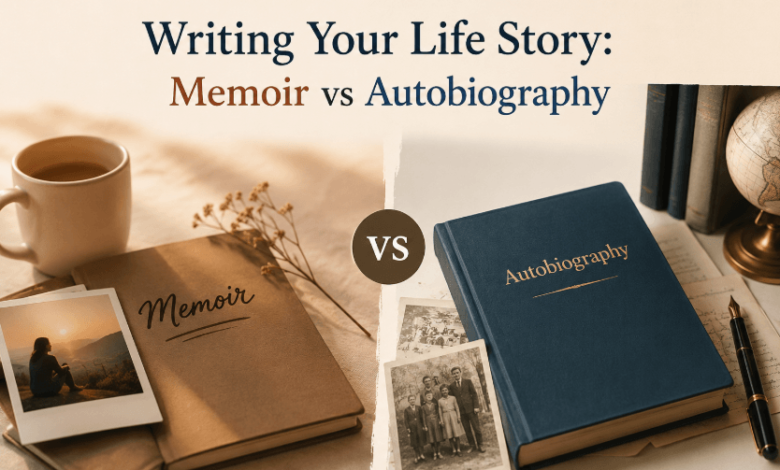
Most people who decide to write their life story spend the first few months asking the wrong questions. Where do I start? Do I use real names? Should I include my childhood or just the years that shaped everything else?
None of those are the first question. The first question is what kind of book are you actually writing.
Memoir and autobiography are not the same thing. Most people use the words interchangeably. Most people who do end up writing something that satisfies neither form and wonders why it feels incomplete.
The clearest way to understand the difference is this. Memoir has jurisdiction over feeling. Autobiography has jurisdiction over fact.
An autobiography is a record. It moves chronologically through a life, accounts for the significant events, identifies the people involved, and presents the facts in sequence. It asks what happened and when. It is the appropriate form when the life being documented has enough historical, professional, or cultural weight that a reader needs the complete picture to understand any particular part of it.
Memoir is something else entirely. A memoir does not try to cover a whole life. It covers a period, a theme, a transformation. It asks not what happened but what it meant to be there when it happened. The facts are present but they serve the emotional truth rather than the other way around.
This distinction matters more than most first-time writers realize, because the form you choose determines nearly every structural decision that follows. Scope, pacing, how you handle the other people in your story, what you leave out, how honest you allow yourself to be.
The most common reason a life story manuscript gets abandoned halfway through is not writer’s block. It is the writer trying to be fair to everyone in the story rather than being true to their own experience. Autobiography invites fairness. Memoir requires honesty. Those are not the same thing, and attempting to do both at once produces a book that satisfies neither standard and exhausts the writer in the process.
There are writers for whom neither form is quite right, because their goal is not to document their life or to explore its emotional territory but to use their experiences as the foundation for practical guidance for readers going through something similar. That is the instinct behind self-help ghostwriters, and it is a genuinely different form again. The author’s story becomes a vehicle for the reader’s transformation rather than the subject of the book itself.
And there are writers whose relationship with their own life is filtered so completely through imagination, through invented worlds and symbolic landscapes, that the truest version of their story might actually live inside fantasy writers for hire rather than nonfiction at all. Some of the most honest accounts of real human experience exist inside invented worlds precisely because the distance of fiction allowed the writer to go further than memoir ever could.
See also: How Lifeguard Training Transforms a Lifeguard into a Lifesaver?
The question of which form is right for you comes down to what you want a reader to walk away with. If the answer is understanding of your life and what you have done with it, autobiography. If the answer is recognition of an experience you both shared, memoir. If the answer is a changed way of thinking, self-help. If the answer is a feeling that could only live inside a story that never happened, fiction.
Choose deliberately. The shape of everything that follows depends on it.