While every house has its own signature aroma, it should never be an unpleasant one.
However, when a home begins to develop a musty, stale, or sour smell, the main reason for that is almost always the carpeting.
Here are 8 carpet habits that spread odours at home, so you can learn what not to do and how to reclaim your space and restore everything to normal.
1. Not Addressing Spills Right Away
The most common mistake homeowners make is the belief that a small spill will simply dry out and become harmless. Whether it is a glass of wine, a drop of juice, or a pet mishap, the liquid does not simply evaporate into thin air.
Gravity pulls the moisture deep into the carpet pile and, more importantly, into the underlay and the subfloor. Once the liquid reaches the base of the carpet, it becomes trapped.
The surface may feel dry to the touch, but the deep-seated moisture creates the perfect environment for bacteria and mould to thrive.
This hidden biological growth is the primary driver of sour, damp smells. Immediate action is vital; if a spill occurs, it must be blotted—not rubbed—until the moisture is entirely removed.
If the spill has already reached the underlay, surface cleaning alone will not prevent the odour from developing.
2. The Dangers Of Over-Wetting During Spot Cleaning
When people do decide to clean a stain, they often fall into the trap of using too much water. While the intention is to rinse the stain away, the result is often a saturated carpet that takes too long to dry.
Carpets, particularly those with a synthetic backing, are not designed to hold water. When they are soaked during a DIY attempt, the moisture can sit for days, especially in the cooler, damper months typical of the British climate.
This excessive moisture promotes the growth of mildew and bacteria within the carpet fibres. To avoid this, spot cleaning should involve minimal moisture and, crucially, rapid drying.
Turning on a fan or opening windows to improve ventilation immediately after cleaning is essential. If the carpet remains damp for more than a few hours, the risk of developing a musty odour increases significantly.
3. Relying On Harsh Store-Bought Chemicals
Many supermarket carpet shampoos promise to “lift” dirt and leave a fresh scent. However, these products often contain high concentrations of surfactants and detergents that are difficult to rinse out.
When these chemicals are left behind in the carpet fibres, they leave a sticky residue. While your carpet might smell like “Spring Meadow” for a few days, that residue acts as a magnet for future dirt and dust.
Within weeks, the carpet becomes dirtier than before you cleaned it, and the chemical scent begins to mingle with the trapped dust, creating an even more unpleasant, cloying odour. Professional cleaners often refer to this as the “residue cycle.”
True cleaning should leave the fibres pH-balanced and free of any sticky film, which is why professional-grade extraction is so different from off-the-shelf foam cleaners.
4. The Rapid Vacuuming Technique
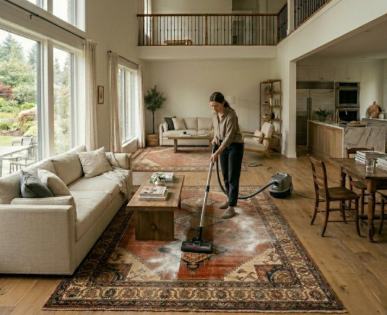
Vacuuming is a chore that many people rush through. It is easy to view it as a quick run around the room, but vacuuming is a mechanical process that requires time and technique. If you vacuum too quickly, you are only skimming the surface of the carpet.
The suction does not have enough time to pull the dust and debris out from the base of the fibres, where the odours originate.
Furthermore, if your vacuum bag or canister is full, the suction power is drastically reduced, and you are essentially blowing air through a layer of trapped dust, which contributes to that stale “vacuum smell” in the room.
Effective vacuuming requires slow, deliberate strokes. It should be done in multiple directions to lift the fibres and allow the suction to remove the embedded particulates that serve as the food source for odour-causing bacteria.
See also: How Modern Stair Designs Are Changing British Homes
5. Ignoring The Pet Accident Factor
If you share your home with pets, you likely already recognise that they can be the source of certain odours.
However, even if you clean up visible accidents, the underlying issue often remains. Urine, even when cleaned from the surface, contains uric acid crystals that are not water-soluble.
These crystals bind to the carpet fibres and the floor beneath, and they are incredibly persistent. When the humidity in the room rises—a common occurrence in homes—these crystals react, releasing a sharp, ammonia-like smell.
Standard household cleaners cannot break down these crystals; they only mask the scent temporarily.
Unless you use specialised enzymatic cleaners designed to digest the proteins in urine, the odour will persist, and your pet may even be encouraged to return to the same spot.
6. Wearing Outdoor Shoes Inside
It is a common habit, but wearing outdoor shoes inside the home is a major contributor to carpet degradation and odour.
The soles of your shoes act as a conveyor belt for the outdoors, bringing in mud, oil from roads, bacteria from pavements, and decaying organic matter.
In a historic city like St. Albans, where many homes have older carpets, these contaminants are easily ground deep into the fibres.
Once these outdoor pollutants are embedded, they are difficult to remove with standard vacuuming. They begin to break down, releasing organic odours that settle into the carpet and eventually permeate the entire room.
Establishing a strict “no shoes inside” policy is the single most effective way to prevent the buildup of these unwanted scents.
7. Neglecting The Furniture Rotation
When was the last time you moved your sofa or heavy bookshelves? Most homeowners clean around their furniture, leaving the areas underneath and behind untouched for years. These “dead zones” are the perfect hiding spots for dust, dander, and shed skin cells.
Because there is little to no airflow in these areas, the accumulation of organic matter is undisturbed, leading to a concentrated, musty smell. Additionally, heavy furniture compresses the carpet pile, making it harder for the carpet to “breathe.”
Rotating your furniture occasionally and vacuuming the areas underneath is essential for preventing these pockets of stagnant air and odour from developing. It also helps to prevent the carpet from wearing down unevenly, keeping the texture consistent across the room.
8. Skipping Professional Maintenance Cycles
Perhaps the most common habit is waiting until the carpet looks visibly dirty before seeking a deep clean. By the time a carpet looks dingy, it is likely already heavily saturated with dirt, allergens, and bacteria.
The most effective way to manage odours is to prevent them through regular, scheduled maintenance. While DIY efforts are helpful for day-to-day upkeep, they cannot match the industrial power of professional equipment.
High-pressure steam extraction, for example, reaches temperatures and suction levels that consumer machines simply cannot replicate.
This is why contacting professional carpet cleaning in St. Albans on a semi-annual or annual basis is the industry standard for maintaining a fresh home.
Professionals can neutralise odours at the molecular level, restore the pH balance of the fibres, and remove the deep-seated grit that contributes to the breakdown of the carpet’s structure.
Conclusion
To keep your home smelling fresh, you should always take good care of your carpeting.
By adjusting your approach to cleanliness and carpet maintenance, you can significantly reduce sources of unwanted smells.
However, remember that even the most diligent household cleaning regime has its limits. By breaking these 8 habits and using professional cleaning from time to time, you ensure that your floors remain hygienic and your abode always smells pleasant.