Digital Tools vs. Academic Rigor: How Australian Universities are Redefining Nursing Education

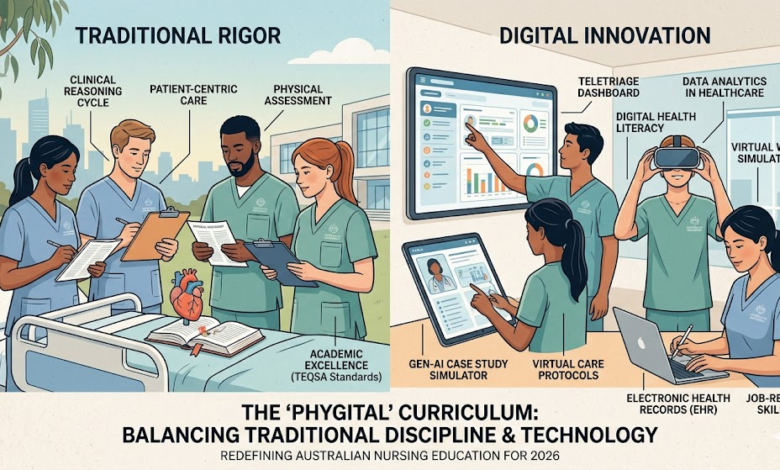
The Australian healthcare landscape is undergoing a seismic shift. As we navigate through 2026, the Department of Health and Aged Care continues to emphasize a “digital-first” approach to clinical practice. However, this evolution presents a unique paradox for the nation’s top-tier universities. How do institutions maintain the prestigious “Gold Standard” of Australian medical training while integrating the rapid-fire advancements of Generative AI, virtual reality simulations, and telehealth protocols?
The answer lies in a delicate recalibration of academic rigor. It is no longer enough for a nursing student in Sydney or Melbourne to master the clinical reasoning cycle on paper. They must now demonstrate “Digital Health Literacy”—a competency now mandated by the Australian Nursing and Midwifery Accreditation Council (ANMAC). This intersection of technology and traditional discipline is redefining what it means to be “job-ready” in a post-pandemic economy.
The Rise of the “Phygital” Nursing Curriculum
Australian universities, from the University of Queensland to UTS, have transitioned to a hybrid “phygital” model. This approach combines physical clinical placements with high-fidelity digital simulations. While these tools offer students a safe environment to fail and learn, the academic workload has intensified. Students are now expected to manage complex data analytics alongside traditional patient care plans. Consequently, many students find themselves overwhelmed by the dual demand of technical proficiency and academic excellence, leading to an increased reliance on professional assignment help in australia to bridge the gap between classroom theory and digital application.
Data-Driven Insights: The 2026 Academic Landscape
According to recent 2025-2026 enrollment data, there has been a 14% increase in domestic nursing student attrition rates, primarily attributed to “cognitive overload” from new digital assessment modules. The Tertiary Education Quality and Standards Agency (TEQSA) has responded by implementing stricter guidelines on how AI can be used in nursing assessments, ensuring that while tools are utilized, the core “human-centric” rigor remains untouched.
The Clinical Reasoning Cycle in the Digital Age:
The infographic above illustrates how digital data—from Electronic Health Records (EHR) to AI-driven diagnostics—now feeds into every stage of the traditional clinical reasoning cycle.
Maintaining Rigor Amidst the AI Revolution
One of the primary concerns for Australian academics is the preservation of critical thinking. With the emergence of Next-Gen NCLEX standards being adopted globally, Australian nursing boards are focusing heavily on “Case-Based Learning.”
The rigor hasn’t decreased; it has changed shape. Instead of memorizing dosages, students must now analyze why an automated system suggested a specific dosage and identify potential algorithmic biases. For those struggling with the complex documentation required for these modern modules, seeking specialized nursing homework help has become a strategic way to understand these nuanced clinical case studies without compromising their grades.
Key Takeaways for 2026 Nursing Students
- Digital Literacy is Non-Negotiable: Proficiency in EHR and telehealth platforms is now as vital as physical assessment skills.
- TEQSA Compliance: Always ensure your digital research tools align with the latest Australian academic integrity standards.
- Focus on Case Studies: Priority is moving away from rote memorization toward complex clinical decision-making.
- Balance is Key: Use academic support resources to manage the heavy documentation load of modern nursing degrees.
See also: Why The Advanced Revolution In The UK Online Learning Will Change How You Think About Education?
Frequently Asked Questions (FAQ)
Q1: How are Australian nursing degrees changing in 2026?
Universities are integrating more AI-driven simulations and “Digital Health” units to align with the National Digital Health Strategy.
Q2: Is using academic help services allowed in Australia?
Yes, provided they are used as study guides and tutoring resources that adhere to your university’s academic integrity policy and TEQSA guidelines.
Q3: What is the most difficult part of the new nursing curriculum?
Most students find the integration of data science and pharmacology-based “Case-Based Learning” the most rigorous aspect of the current BSN programs.
About the Author
Lachlan McKenzie is a Senior Academic Consultant at MyAssignmentHelp. With over a decade of experience in the Australian higher education sector, Lachlan specializes in curriculum alignment and nursing pedagogy. He is dedicated to helping students navigate the complexities of modern academic standards while maintaining the high levels of rigor required by the AQF (Australian Qualifications Framework).
References & Data Sources
- Australian Nursing and Midwifery Accreditation Council (ANMAC), 2026 National Competency Standards for the Registered Nurse.
- Tertiary Education Quality and Standards Agency (TEQSA), Annual Report on Academic Integrity in the Age of AI (2025).
- Australian Government Department of Health, National Digital Health Strategy 2023–2028: 2026 Progress Review.
- Journal of Advanced Nursing (AU Edition), “The Impact of High-Fidelity Simulation on Student Stress Levels,” Vol 82, Issue 3.