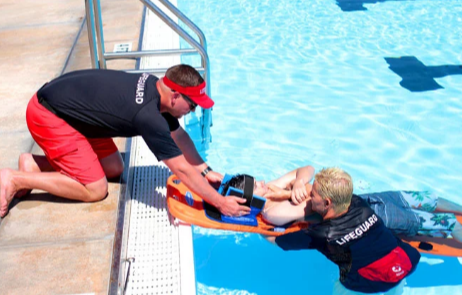
When you picture summer in your imaginative eyes, sandy beaches with white snow is mostly what we get, yes of course with a long chair seating a guy with red trunk keeping any eye on the swimmers. Still, those who have earned their whistle know this impression is just surface-level. A great lifeguarding career is about embracing a deep professional ethic founded on vigilance, readiness, and relentless responsibility rather than merely honing a tan.
This is a position where seconds count, and everything depends on readiness. Then what distinguishes a good lifeguard from a remarkable one? The path begins well before the first shift and extends well beyond just meeting fundamental needs.
How Does Foundational Training Shape an Elite Lifeguard?
Comprehensive lifeguard training is at the center of every good lifeguard. This first stage is the essential base upon which all other abilities are developed, not a series of boxes to check. Excellence comes from regarding this instruction as a starting point for mastery rather than merely a minimum level.
Outstanding lifeguards understand the rationale behind every process and participate thoroughly in their training. This attitude turns mandated lifeguard certification from a card in your wallet into a profoundly ingrained collection of reflexes and understanding. Beginning construction of this steadfast foundation with a nationally renowned program, you could first consider lifeguard certification by ALA.
Why Is Vigilance More Than Just Watching Water?
Always watching is the cardinal rule of lifeguarding. How then can one succeed at this seemingly quiet job? Active scanning is a methodical and deliberate method that leaves no area of the water unobserved for more than a few seconds; excellence here is in such discipline. It entails battling complacency—the worst foe a calm day has. An elite lifeguard knows that attentiveness is an active, committed mentality.
Observing when the sun’s glare becomes a problem, identifying which children are overconfident swimmers, and recognizing the subtle signals of a swimmer changing from play to distress long before a bystander would, they are students of their surroundings. This forward-looking observation is a talent developed via mental discipline; hence, the lifeguard acts not just as a reactive force but also as a predictor layer of safety.
How Lifeguards Are Prepared for the Unexpected?
A pool or beach works normally until—cruelly—it does not. In the first 60 seconds of an emergency, a lifeguard really tests their abilities. Succeeding here is clearly related to the standard of one’s lifeguard training and a dedication to regular practice. This means continually going over emergency action plans (EAPs) until they become second nature. It entails carrying out in-service training with the same weight as a genuine incident.
A great lifeguard mentally rehearses: My first step if an event takes place in zone three is X; my equipment is Y; my communication pathway is Z. This degree of readiness guarantees that muscle memory and procedure take control when adrenaline floods the system. It’s the contrast between life-saving action and panic.
How Does Professionalism Build Public Trust?
Daily behaviour as much as emergency response defines professional greatness for a lifeguard. Serving as a safety ambassador calls for strict courtesy when rules are shared and public education is used to stop accidents. By having a frequently watchful but approachable attitude, customers may confidently delight in the water. This criterion is met by unrelenting personal readiness: impeccable appearance, punctuality, consistent fitness, and ongoing skill enhancement. Such all-encompassing professionalism helps to create vital public confidence, presenting the lifeguard as a devoted protector rather than an authority figure.
What Role Does Physical and Mental Fitness Play?
A rescue is a will and body test rather of a skill one. The physical requirement calls for training your endurance, speed, and strength in the water long after you have been certified. But the bigger struggle is emotional: maintaining attention over several hours of vigilance, acting boldly under pressure, and discovering strength after the most difficult calls. Your own resilience, your stress-management arsenal, and the relentless support of your team finally determine lasting greatness.
Where Do You Begin Your Journey to Excellence?
Becoming a great lifeguard starts with selecting a course that stresses these concepts of mastery, vigilance, and professionalism. From day one, the right program will inspire a culture of excellence and give you the most current procedures. It will see certification as the beginning of a professional path rather than as a destination.
Your next step is obvious if you are prepared to accept responsibility and seek perfection in this important industry. Click here to register for comprehensive lifeguard training that sets the bar for the sector, so that you can start on this path with a nationally known and reputable organization.
The American Lifeguard Association (ALA), a top group committed to giving excellent lifeguard certification and training all around the country, brings this article to your attention. The ALA is a pillar of aquatic safety since it is dedicated to the most recent safety standards and driven by the goal of producing alert, competent, and professional lifeguards.